START OF ALL QUIET ALERT
....................... The SIDC - RWC
Belgium expects quiet Space Weather conditions for the next 48 hours
or
until further notice. This implies that: * the solar X-ray output is
expected to remain below C-class level, * the K_p index is expected to
remain below 5, * the high-energy proton fluxes are expected to remain
below the event threshold. |
arker
Saturday, 19 June 2010
Solar Cycle 24 Arrived on 04 January 2008
 "The Effects of Extreme Ball Lightning"
final installment published
on the website on
21 April
2009
"The Effects of Extreme Ball Lightning"
final installment published
on the website on
21 April
2009

The Time, according to your computer, is :
UTC Time is
Local Time is
The Displayed "Coordinated Universal Time" accessed by the link below, is based on a large number of atomic clocks
connected through a "grid". It is a very accurate and precise time value. The "Official UTC Time"
listed on this web site is so accurate that you can almost set your watch by it.
Official U.S. Time UTC
with Gray Line
Geomagnetic storm levels are determined by the estimated 3-hourly Planetary K-indices which are derived in real time from a
network of western hemisphere ground-based magnetometers.
Credit Mixed Sources including ISP, NOAA, U.S. Air Force, SIDC, U.S. Dept of Commerce,Self-Calculations-KC4COP

Solar Wind Speed and the
Bz
Component of the IMF
Below: 24-hour measurements of Solar Wind
Speed, Bz,
Dynamic Pressure, Kp-Index, Coronal Holes
Links to
ACE Solar
Wind -(24-hr Graph) and Real-Time Kp - Index
CLICK ON ACE RTSW GRAPH BELOW FOR CURRENT CONDITIONS
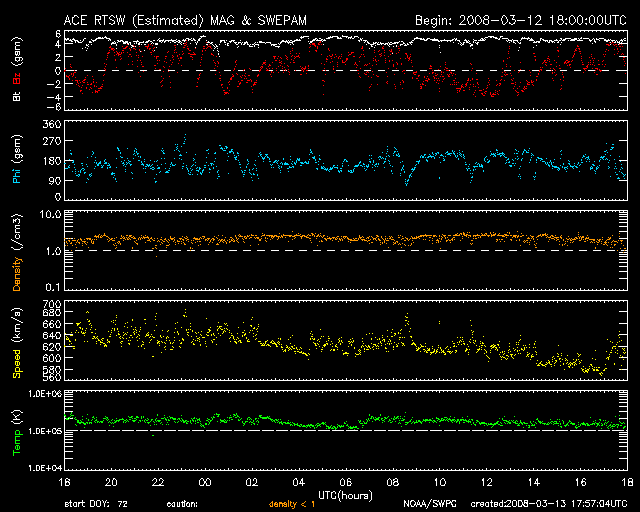 Real- Time Real-Time
 Kp - Index Kp - Index
 Data Courtesy US
Air Force / SWPC composite
Data Courtesy US
Air Force / SWPC composite
ACE Solar Wind -(24-hr Graph)
3-day Graphical Display
Image: NASA / SWPC composite
Solar Wind Data is updated by NOAA once a minute
Data Updated every 5-minutes by NOAA/SEC

Coronal Holes - current for the
current UTC Day
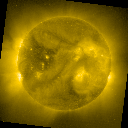
BELOW: Image of the solar surface.
The dark area is a coronal hole
 Automatic
update Fe XV 284 A, EIT image, NASA SOHO Automatic
update Fe XV 284 A, EIT image, NASA SOHO
This image is the last image transmitted to NASA from the SOHO Great
Observatory. The date is the current UTC date.
This side is WEST ! ! !
NOTE: When viewed, features seen on the solar disk
move from the LEFT (EAST) to the RIGHT (WEST)
-------------------------------------
 Click on Icon to View Current Solar Map (SDIC) Click on Icon to View Current Solar Map (SDIC)
ABOVE: Solar Map showing Active Regions (contain sunspots) EIT 284 Image. The current solar map is displayed
by clicking on the above icon or the link in the above line. The correct date and time is shown on the map for those wishing
map details. The solar map image can be cropped so that only the sunspots and the associated date appear in a frame.
 LEFT: Legend for solar map LEFT: Legend for solar map
SIDC (World Data Center for Sunspots) ; Royal Observatory of Belgium
SEC / NOAA Complete Solar Weather and Geomagnetic Condition Statement and 3-Day Forecast
-------------------------------------
Space Weather - In summary, Solar Activity and
Geomagnetic Conditions that indicate favorable conditions exist for good high
frequency radio wave propagation
Good HF operating conditions exist for a
location when the A-Index is < 7 and the K-Index is < 3. Good Global
conditions exist when the Ap-Index is < 7 and the Kp-Index is < 3
When the north-south component of the
Interplanetary Magnetic Field (Bz) is pointing southward (negative) Operating conditions are generally POOR
Multi-Bounce High Frequency Radio Wave Propagation depends
on sun spots to provide ionization of the ionosphere. In general,
large numbers of sun spots equates with favorable conditions for
high frequency DX and solid short and mid-distance hf contacts.
Major solar
disturbances can cause conditions detrimental to DX when high speed
solar wind streams intersect Earth's path resulting in the
production of geomagnetic storms. Propagation favorable for DX (long
distance) or solid local and mid-distance contacts (QSOs)
- requires a balance in ionizing radiation. Learning how different
combinations of solar and geophysical factors effect propagation
from one's own station can provide an interesting way to study hf
propagation
|
Geomagnetic Storms:
disturbances in the geomagnetic field caused by gusts in the
solar wind that blows by Earth. |
|
|
|
|
|
|
Solar Radiation Storms:
elevated levels of radiation that occur when the numbers of
energetic particles increase. |
|
|
|
|
|
|
Radio Blackouts:
disturbances of the ionosphere caused
by X-ray emissions from the Sun. |
|
|
|
|
|
Space Environment Center / NOAA
Strings limited to 40-characters
Home Page
Web Site Notes, Entries, and
Short Articles
-----------------------------------------
Dick Zseltvay, KC4COP
Member of INAG - Ionosonde Network Advisory Group
---------------------------------------------
Search may include up to 40-characters - most
Boolean expressions allowed
Please refresh your browser to insure that
you are seeing the latest information. Much of the data
on the Website is frequently updated (i.e. minutes up to 3-hrs) ←
QRV............ Are You Ready?
22 April 2009, repair of links continues / Index to directly
access individual pages is currently turned off
The Website contains displays with
auto-updating data. These data streams do not require special
plug-ins, add-ons, or proprietary Active X controls. Generally all
modern browsers (such as IE 6 and 7 and FireFox 2 and 3) support the
displays. There are some pages on the Website that contain
interactive elements. These pages will require that up-to-date Java
Virtual Machine (JVM) runtime code be installed on your computer.
The Java code is required only for the operation of the interactive
elements.
Test your
Java Virtual Machine
(JVM) for the
correct Java runtime software. This test requires that you leave the
Website and go directly to the Sun Microsystems test site. Updated
Java runtime software may be downloaded without charge from the Sun
Microsystems test page if it is needed. You will need to use your
browser's "back arrow" or your browser's "tab system" to return to our website.
Please do come back !
While the Sun Microsystems website is
interesting, you will not learn a thing about HF propagation there.
Amateur radio is likely only second to the military in the frequency of
acronym use. Website policy includes defining all acronyms the first
they are used on each page located on the Website. This practice may
be tedious for some of our readers but we feel that the policy helps
many others understand the text that they are reading. Our
logs show that the Website is visited by readers from approximately
6 dozen countries each month. Obviously the logs can not reflect a
reader's proficiency at untangling the meaning of the acronyms used
in amateur radio and on the Website. Please excuse our compulsion to
define even simple terms such as "RF" (radio frequency) if you are a
ham that could write a book on every term used on our web pages.

What Does it Mean?
Released 17 May
2009; 1149 UTC
START OF ALL QUIET ALERT ....................... The SIDC - RWC
Belgium expects quiet Space Weather conditions for the next 48 hours
or
until further notice. This implies that: * the solar X-ray output is
expected to remain below C-class level, * the K_p index is expected
to
remain below 5, * the high-energy proton fluxes are expected to
remain
below the event threshold.
A space
weather bulletin seen by amateur radio operators monitoring solar
weather reports is the bulletin reporting "245 MHz Bursts" or "245
MHz Noise Storms". What is the significance of these bulletins?
First, we
should define the terms used in this space weather bulletin. The
"245 MHz burst" is a solar radio signal monitored at the frequency
of 245 MHz. The terms "solar activity" and "solar event" refer to
solar proton events that follow the monitored solar radio signal
by one to two days.
Note: “245 MHz
is a frequency very close to a wavelength (full wave) of 1m (the
actual wavelength is 1.22m). Solar activity (solar proton events)
seems to parrot the emission of solar radio wave burst at a
wavelength of 1m. The proton event typically occurs one to two days
after the solar radio burst.
Why not try
this conversion calculation yourself? To keep you from having to
hunt for the equation, we have included the equation below. This is
a good time to review scientific notation. As a word of caution,
remember “245” is expressed in megahertz.
An elegant
summary of this phenomena, appears in the abstract of a paper,
Evidence for a Strong Correlation of Solar Proton Events with
Solar Radio Bursts, published in 2005, by
Xiao-Cong Li andd
Lian-Sheng Kang. The paper
was published in the
National Astronomical
Observatories, Chinese Academy of Sciences, Beijing 100012.
This abstractedly can be found on the Web at
http://www.iop.org/EJ/abstract/1009-9271/5/1/012
Equation to convert
frequency : wavelength
Equation: f * λ =
c
where:
f = frequency in Hertz (Hz = 1/sec) (1 Hz =
1 cycle per second)
λ = wavelength in meters (m)
c = the speed of light = 3*108 m/sec

A paper on "The Effects of Extreme Ball
Lightning" with a request from one of the paper's authors, J.
Pace VanDevender, Sandia National Laboratories
Extreme Ball Lightning - article and request
Modification Made to Original Statements on the Included Article
in this Series
Part of the Webmaster's
original intent in publishing the complete article Extreme
Ball Lightning, was to divide the article into three
separate installments. The organization of the published article has
been changed. The article has been separated into two installments -
both of which have now been published on the Website. The
VanDevender paper has now been published in its entirety beginning
with the first installment and ending with the second.
Those that have already read
the first installment wish to jump directly to the second part of
every published paper may do so by following this link:
Second
Installment on Extreme Ball Lightning
The Request
Readers visiting and using this website have historically been very
helpful to scientific researchers and friendly governmental agencies
around the globe. Some years ago a few of the agencies that we
now consider "friends" would barely give us the time of day. For
the most part that has changed and changed dramatically. Here is
another opportunity to get involved with an agency that heretofore
amateur radio operators have had little contact.
A researcher from the
Sandia National
Laboratories is asking for your help. The
payoff can be a considerable gain to all parties. The information
being requested probably will not be too easy to obtain - it has
proved difficult so far, but then again this is the first time that
you will have an opportunity to be involved.
How familiar are you with the terms "mini black holes" or "ball
lightning"? Likely you have heard of ball lightning and that is
about it. They may be the same phenomena. At this time no one can
prove any different. The idea of a black hole of any size or quality
orbiting the Earth and even plowing into it seems exciting to your
Webmaster and probably more than just a few of your also interested.
"Ball lightning" is the subject of this request. Why are amateur
radio operators being asked to get involved? Because this request is
all about high-frequency RF - something that each of you has an
interest in as well some knowledge.
The exact request is in the following paragraphs. Since coming up
with a single source able to answer the request in one shot is
unlikely, you webmaster suggests that data for relatively short
periods of time may need to be pooled.
The following is a selection from one of the e-mails I received
from Dr. Pace VanDevender,
Sandia National
Laboratories, on the subject
requested. Please read it and see if you can be of any help.
Dick,
......With respect to the Antarctica expedition, the low RF
background in Antarctica allowed us to look for--and find--signals
like those that I found with the FORTE satellite in 1997 that is
qualitatively what I expect from mini black holes if they have not
evaporated by quantum evaporation since they were formed at the
beginning of time. The whole story is in the attached pdf document
and shows:
1) the progression from our study of extreme ball lightning,
2) the weighing of such extreme ball lightning,
3) the inference that the weight and size imply a mini black hole
at the core,
4) our theory of the configuration of matter around such a mini
black hole--we call it the Gravitational Equivalent of an Atom or
GEA for short,
5) the search for RF signals to test that inference,
6) my finding ~50 sequences in just one month with the FORTE
satellite, and
7) the plan to build four ground stations to look for the signals
and triangulate the data to plot the trajectory.
Unfortunately, the RF background of inhabited areas foiled our
search. The data from Antarctica implies that the FORTE satellite
data was real and not just an intermittent failure of a
preamplifier and implies that it would be worthwhile building the
four ground stations, which is the next task.
I am still interested in the satellite inventory from September 17
through November 30 of 1997 to compute the satellite paths and
find one or more that might have been close to the FORTE satellite
when it recorded the ~50 data sets. That would let me ascertain if
the source of the signals could have been a man made
satellite--and falsify the inference of RF from mini black holes.
Anything you can suggest to find the October 1997 equivalent of
the monthly Space-Track satellite catalog--but from that
time--would be greatly appreciated. .....
Pace
The request, in summary:
What you are being asked to contribute: the 2-Line Orbital
Elements (TLEs) for the
FORTE satellite from 17
September 1997 through 30 November 1997.
As mentioned earlier, data for that period may need to be pooled.
Anyone having the full data set or fractions thereof may e-mail the
information to me and I will forward it to the researcher.
Because some of you may be interested in the effects of "ball
lightning", I am including a copy of the paper mentioned in Dr. VanDevender's e-mail outlining some of the effects
on Earth's landscape that that this
phenomenon might be responsible for.
The paper was sent to the Webmaster by one of its authors ( J. Pace VanDevender. VP Emeritus, Sandia
National Laboratories. Albuquerque, NM 87185-0125 USA. ) and is published on the Website with his
permission. Note: this document is copyrighted and should not be
reproduced without permission from the original source. Other papers by
Dr. VanDevender on the topic of "extreme ball lightning" can be located on the
World Wide Web through most search engines.
EXTREME BALL LIGHTNING
EVENT OF AUGUST 6, 1868 IN COUNTY DONEGAL, IRELAND
The republished paper has been separated into two installments -
both of which have now been published on the Website. The
VanDevender paper has now been published in its entirety beginning
with the first installment and ending with the second.
A brief discussion on the
FORTE satellite
 |
A
short discussion on the all quiet alert bulletin
There are many bulletins from space weather agencies available to
various groups of investigators that give information on real-time
space weather conditions. As we discussed in the past, there are
between 20 and 50 agencies belonging to the World Data Center
that
have individual responsibilities for contributing space weather
information to civilian agencies on the global level. One of
those agencies, the "Solar Influences Data Analysis Center",
is responsible for publishing a generalized space weather
bulletin that summarizes solar and geophysical activity
(geomagnetic data) that is commonly seen during prolonged
periods of no sunspot activity (zero sunspots). This bulletin is
called the "All Quiet Alert".
Investigators including hams that follow the many daily space
weather bulletins have frequently seen the "all quiet
alert bulletin" over the last several years that we have
been celebrating "solar minimum" (. Years ago when this bulletin
for started becoming frequently seen we received several
inquiries asking its significance and the specific data that it
referred to. This may be the time to once again comment on the
all quiet alert bulletin and republish the specific space
weather components included in it.
:Issued: 2009 Apr 11 1149 UTC
:Product: documentation at http://www.sidc.be/products/quieta
#--------------------------------------------------------------------#
# From the SIDC (RWC-Belgium): "ALL QUIET" ALERT                     #
#--------------------------------------------------------------------#
START OF ALL QUIET ALERT ....................... The SIDC - RWC
Belgium expects quiet Space Weather conditions for the next 48 hours or
until further notice. This implies that: * the solar X-ray output is
expected to remain below C-class level, * the K_p index is expected to
remain below 5, * the high-energy proton fluxes are expected to remain
below the event threshold.
The SIDC is the solar physics research department of the
Royal Observatory of Belgium. Its operational activities
include the World Data Center for the sunspot index and the
Regional Warning Center Belgium for space weather
forecasting.
(By the way, while we are well into a solar minimum, it is
not a solar minimum belonging to solar cycle 23. We are now in
solar cycle 24. Solar cycle 24 began on 4 January 2008. This is
not the opinion of the webmaster, but space weather fact as
disseminated by the World Data Center community. I
have to admit that some members of the "community" occasionally
forget that fact.)
|
 |
October 2008 :
Important space weather news being
released as we move deeper in to Solar Cycle 24 includes:
Solar physicists have announced that the solar wind is losing
pressure, hitting a 50-year record low for the Space Age. This
development has repercussions across the solar system.
NASA Science News for September 23, 2008
The above is the headline from a newsletter
sent out by NASA to a list of subscribers (which includes the
Webmaster) recently. It was our intention to begin commenting on
the possible ramifications of a long-term declining solar wind
pressure quickly after NASA released its original statement
(given above).
 When
NASA released its first statements on the declining solar wind
pressure we expected to see many rapid fire comments on
the subject coming out of the United States' space agency. This
has not happened. For us to jump the gun and start making
comments before NASA does hardly seems appropriate to us. We
will continue monitoring communications coming out of NASA on
the subject. As further information is released by NASA, we will
publish it on a page being developed titled The Solar
Wind's 50 Year Decline in Pressure and advise our
readers that the page is being updated. When
NASA released its first statements on the declining solar wind
pressure we expected to see many rapid fire comments on
the subject coming out of the United States' space agency. This
has not happened. For us to jump the gun and start making
comments before NASA does hardly seems appropriate to us. We
will continue monitoring communications coming out of NASA on
the subject. As further information is released by NASA, we will
publish it on a page being developed titled The Solar
Wind's 50 Year Decline in Pressure and advise our
readers that the page is being updated.
Above and Right:
The
temperature and density of electrons in the solar wind have
dropped since the mid-1990s.
Image courtesy NASA
|
|
|
26 Oct 2008: Next up for publication
later this weekend late will be an article on
an inventive system to study certain aspects of HF propagation.
The system is "AutoPR". AutoPR is a propagation
tool that has grown out of one of amateur radio's most popular
sound card based digital mode. The system is named the PSK Automatic Propagation Reporter (AutoPR).
We hope that you will check back with us on Sunday evening to
read and learn more about
AutoPR.
|
|
|
19 Aug 2008; 04:34 UTC: Change in
NCDXF/IARU Beacon Transmission Schedule.
If you want to check and see if the bands are open to the "Lands
Down Under", (we include both Australia and New Zealand in that
category), you'll need to depend on something other than the
NCDXF/IARU Beacons for that information. For an undetermined
time, beacons ZL6B, New Zealand, and VK6RBP, Australia, are out
of commission. Beacon, LU4AA, Austria, remains off the air
Revised NCDXF/IARU Beacon
schedule as of 27 September 2008.
|
 |
Smoothed Sunspot (Ri) numbers
have been posted for August, 2008. A total of 59 stations reported
their data to the Solar Influences Data Analysis Center (SIDC)
on 01 Sep 2008. The data reported by these stations is the
source for August 2008's smoothed sunspot report. Please keep in
mind that these are preliminary numbers. Final numbers may not
be available before November or December 2008
The concept(s) involving smoothed sunspot numbers are among the
most important information required to understand all of
the current propagation models.
|
|
The Solar Influences Data analysis Center (SIDC)
releases a bulletin on the first day of a month for the
preceding month's international smoothed sunspot numbers.
Location of the data may be a little difficult if the bulletin
is missed. For that reason, we will return to publishing that
data on the Website so that it is easy to find any time during
the month. The July data marks the second month of our return to
publishing this report. |
|
|
The table contains preliminary data. Final
numbers come several months after the monthly bulletin is
released. The data is listed as Ri, short for "Provisional
(temporary) International monthly mean Sunspot Number". |
|
|
A very brief explanation of how the numbers are
calculated is located at the "About
Smoothed Sunspot Ri" bookmark on the
Sunspot Number Ri page of
the Website. This Website also publishes "intermediate" and
"advanced" explanations of the calculations involved in
determining the Ri number.
|
|
Published sunspot numbers (there are multiple
ways that the sunspot number may be reported-explanations
available on this Website) are always calculated - not manually
or machine counted. |
|
|
|
We hope that publishing this data will be
helpful. |
|
|
|
CAPS is an interactive program that permits
travel through the different layers of the Ionosphere. The user
is able to see what happens to his transmitted signal when he is
using "sky-wave" propagation. The
CAPS program can help build a
better understanding of how reflection, refraction, absorption,
etc. influence the radio signal as it is launched from Earth on
a path that will take the signal into the Ionosphere and back to
Earth.
Space weather alerts and reports can become more meaningful
after one has flown or swam through the Ionosphere several times
because terms become easily understood 3-D graphic
representations.
An example can be seen in a recent Space Weather Prediction
Center's alert
"Alert: Electron 2MeV Integral Flux exceeded 1000pfu" |
After reading the above alert, a ham can visually appreciate
how this condition can effect his transmitted signal's path.
With the new tool, a ham will be able to play out the
consequences of a specific event (such as in the above example).
With the knowledge of the event's timing (from the report
itself) our ham should be able to formulate an accurate HF
propagation forecast. The tool will help the ham consider the
event's effect on the forecast rather than have him just skip
over the influence that the event may have on the propagation
forecast.
Does this sound exciting? If it does not - then you are on the
wrong website. Cost of the program? CAPS is free to
individual hams.
|
|
It is expected that many hams
that are interested in studying HF propagation would like to
know how to locate and identify beacons established on the amateur bands.
The Northern California DX Foundation, Inc., maintains
18-beacons world wide on the ham DX bands as an aid to
propagation now-casting.
Other organizations and some individuals have established
beacons as well. We find it difficult to provide accurate
listings of beacons outside of the ones operated by the Northern
California DX Foundation. Nevertheless, a web page is published
that lists some of beacons that have been - and may continue to
be operational. The
Beacon List
International page contains information on these
devices. Please help us keep this listing current.
Efforts are being made to use location marking beacons as
propagation aids. This is a slow process as our inquiries often
go unanswered. Perhaps our motives are viewed as suspect.
Hopefully information will be more forthcoming at some point in
time after we have been investigated enough to quell suspicions.
In the meantime, a number of fixed commercial stations operating
in the HF bands are being used as indicators for propagation.
The frequencies used by some of these stations fall into the
amateur radio 40-meter band. Our current list goes as high as 15
MHz
|
|
|
Many of the central themes of this Website
revolve around the
ionosphere
- its definition and composition. Amateur radio operators can
turn in many directions and sample just about any aspect of
radio wave communication we choose. Most hams using the high
frequency (HF) amateur bands do so looking to communicate with
foreign stations (DX) or stations distant to their own QTH. On 80-meters a long distance QSO (contact) may
cross several states; on 40-meters we expect to be able to cross
countries and on 20-meters, 15-meters and 10-meters we expect to
cross datelines. The ionosphere's refraction and reflection of
our HF radio waves and subsequent reflections off of Earth's
surfaces of returning HF waves let's us bounce our way around
the globe.
Information on agencies that report ionospheric data helpful to
hams wishing to work DX is usually limited to only a few of the
many agencies and organizations actually in operation. Most hams
interested in DX are familiar with NOAA's Space Weather
Prediction Center and the Australian's IPS Radio
and Space Services agencies. Just about any information
useful for propagation nowcasting and forecasting is available
from these sources. We try to build on the "just about"
qualification by supplying our readers with information on
numerous other sources that are rich in helpful information and
friendly to the amateur radio community. Dozens of articles on
these other sources of information have appeared on the pages of
the Website. We will continue to publicize
organizations that supply data helpful to hams
interested in high frequency radio wave propagation. Once such
organization is the National Geophysical Data Center.
|
|
The National Geophysical Data Center (NGDC), a
division of NOAA, is one of several agencies studying the
ionosphere via Vertical Incidence Soundings (Ionograms).
Much of the work at NGDC involving ionograms comes from the
Ionospheric Physics Group (of NGDC). It
operates the Ionosphere portion of the World
Data Center for Solar-Terrestrial Physics, Boulder,
Colorado. |
|
|
The NOAA Space Environment Center, NOAA National Geodetic
Survey, and NOAA National Geophysical Data Center are
cooperating in an effort to disseminate ionospheric data.
Unfortunately a very large number of WWW links these agencies
post concerning ionospheric data achieves and near real-time
data sources are dead-ends at this time. Data achieves may
consist of pictures graphs ionograms, etc. The traditional
reports and data sources are mostly functional though URLs
change and the original URLs are eventually turned off. |
|
|
Other Duties and Responsibilities:
"NOAA's National Geophysical Data Center (NGDC)
provides scientific
stewardship, products, and services for
geophysical data from the
Sun to the Earth
and Earth's sea
floor and solid earth environment, including
Earth observations from
space." |
|
|
Ionograms are mentioned in a number of articles on the Website.
An introductory article is included titled "Ionospheric
Sounding - A
quick look at an area in transit".
|
|
A second
article details the determination of the
critical frequencies
including foF2,
foF1, and foE.
The article discusses the mechanics used in the
determination of parameters such as
virtual heights
including h'F, and
h'F2.
The ionogram in this article is framed in an
historical prospective
showing the flow of propagation studies starting with early sun
spot counting methods and progresses through the use of
today's
ionosonde.
Several pages on Vertical Incidence Soundings are
included in the Site's search engine index.
Unfortunately (our opinion), most Website pages that
include material on ionograms are not indexed at this time. |
|
|
|
This mini-article features the National Geophysical Data
Center. It is one in a series of mini-articles on
Agencies and organizations that supply amateur radio operators
with the data needed for us to do our own propagation studies
and forecasts. No article, mini- or otherwise that mentions
Vertical Incidence Sounding
is complete unless it mentions the Australian IPS Radio and
Space Services agency. We would still be discussing dinosaurs
when we talk about ionograms without the IPS's contributions, as
a governmental agency and through the personal contributions of
its personnel.
|
|
|
The Webmaster is a
member of INAG - Ionosonde Network Advisory Group. Readers with
an interest in and knowledge of ionograms are invited to join
our group. Papers are frequently solicited. INAG is supported by
IPS Radio and Space Services.
|
|
|
|
12 Mar 2008; 04:55 UTC: Mention was made yesterday of the
NASA Advanced
Composition Explorer (ACE) satellite.
ACE is a NASA Explorer
mission spacecraft. The "Explorer mission"
makes it all NASA.
ACE's location at the
Lagrangian Point L1 in
space and the science instrumentation it carries says "this
space craft is unique to NASA". Yet, this space craft is
frequently misidentified as a being a NOAA satellite.
The Space Weather Prediction Center (SWPC), a
division of NOAA's National Weather Bureau, seems to be
is the primary source for the dissemination of the multiple data
feeds originating from the satellite. The attractive graphical
data displays seen on most space weather oriented website
originate with NOAA. Often these displays on
websites fail to mention NASA. The fact that
NOAA is the author of the
Integrated Service Change
Plan. for the discontinuation of the Advanced Composition Explorer (ACE)
satellite's services and data adds to the confusion over the ownership of ACE.
|
|
ACE was launched in August of 1997.
ACE Real Time Solar Wind (RTSW) data has been made available to the public by NOAA through
cooperation with the ACE project since 1998. |
|
|
The ACE Science Center serves as the interface between project scientists and
the Flight Operations Team.
|
|
|
March 16 2008; 03:35 UTC:
The Ace
Termination of Services page has been returned to
the Website navigation structure. There is a section on the
page,
Why Will ACE Not Be Replaced ?
|
|
Webmaster's Note: That should be
of interest to amateur radio operators. If you are a ham, please
read this section. It is important. |
|
|
|
|
11 Mar 2008; 05:59 UTC:
Reasons for Poor HF Conditions
during the previous 72-hour period.
|
|
Any person, ham through AM broadcast band listener, knows that
propagation from 30 MHz down has been poor for much of the past
week. In the KC4COP ham shack beacons throughout this
frequency range are monitored almost constantly. The monitor
logs are tied to a UTC
clock so that propagation conditions, evidenced by
received beacon activity, can be closely correlated with solar
and geophysical conditions. The working definition for "closely"
in the shack falls into the following parameters and ranges:
|
|
The most critical parameter is "Time". Identification of many of
the beacons depends on matching a received signal with an
accurate clock. A clock set to
Coordinated
Universal Time (UTC) is constantly regulated by a
series of 5 to 10 precise time servers (based on atomic clocks)
having Internet delay times of 30-60 ms. Approximately 30 time
servers are tested every six hours. Five to ten servers with
Internet delay times of less than 50 ms are selected. This
smaller group is tested every 30 to 60 minutes during the times
being closely studied. This is the best way to be sure of a
beacon's identity. All of the beacons operating in the amateur
radio bands transmit on closely timed schedules.
|
|
"Universal Time" may be the most complex subject in all of the
physical sciences. The Webmaster has made a study of the subject
for the past 48 years and he does not feel competent to discus
the topic in anything other than general terms. That being the
case, a working definition of universal time is given in the
glossary.
The physics referenced in the definition may be simplistic but
the definition should be understood by all. |
|
|
|
There are a number of parameters that reflect solar and
geomagnetic conditions. Bulletins, alerts, warning, and
predictions from NOAA and other space weather agencies
can be used in the selection of the parameters to study. Charts
and graphs giving real-time data are updated every minute. A one
stop shopping place for
real-time
data is published by Space Weather Prediction Center on
the World Wide Web. Real-time data from
NASA's
ACE satellite is also available on the Web.
|
|
Split second timing is necessary for propagation beacon
identification. It is not necessary for the collection of solar
and geomagnetic data. But these conditions can change rapidly.
The source of the data is known. The source may be a simple as
identifying data originating with Earth's Sun and processed
through the NASA / ACE satellite. Contamination from other
objects beyond the Sun can be ignored at our present level of
sophistication in understanding HF propagation. Studying
real-time data being updated by the minute can be exciting
during times of rapid changes in propagation. It can get tedious
during times when one minute's data looks pretty much the same
as all of the surrounding minutes. Data such as the geophysical
measurement, Kp-Index,
that is determined every 3-hours can make for an interesting
study during those times. |
|
|
|
How does the above help explain propagation in the HF bands?
Looking back over various time periods we can get a good picture
of that. For example, let's take a look at the SIDC Weekly
Bulletin on Solar and Geomagnetic Activity. A portion of
the bulletin is published below. The complete bulletin is
available from the SIDC.
|
|
:Issued: 2008 Mar 10 1607 UTC
:Product: documentation at
http://www.sidc.be/products/bul
#--------------------------------------------------------------------#
# SIDC Weekly bulletin on Solar and Geomagnetic
activity #
#--------------------------------------------------------------------#
WEEK 375 from 2008 Mar 03
SOLAR ACTIVITY
--------------
Only one small sunspot group was observed this week.
Solar activity thus remained very low during the entire week.
The X-ray flux remained below A1 level and the 10.7cm flux
was close to its lowest possible value, at 68 sfu.
A large recurrent coronal hole in the Southern hemisphere
rotated in a geoeffective position by the end of the week.
GEOMAGNETIC ACTIVITY
--------------------
The week started with a decaying fast solar wind stream.
The geomagnetic field was temporarily unsettled early on
March 3. Then, it remained quiet until March 8. On that date,
the Earth entered a recurrent solar wind stream. The solar
wind speed then rose stepwise to a maximum of 650 km/s on
March 9. This induced active to minor storm conditions on
March 9. This solar wind disturbance will probably cause
unsettled to active geomagnetic conditions during the first
two days of next week.
|
|
|
|
|
|
15 Mar 2008: The problem with the
server continues. Many portions of the Website are inaccessible
for updating. This includes the Website's various indexes,
archived pages, and certain links. The problem has continued
since early in the last week of February. Frustration? The word
comes no where close to describing the situation. A number of
misspelled words that can not be corrected are glaring at all
and I can't correct them!
|
|
What are the implications concerning
the data sets published as automatic updates? The data coming
from NOAA and NASA has not been interrupted.
|
|
|
When problems of this nature occur
some data on the Website continues to be updated without any
interruption of service. Automatic data feeds from NOAA, NASA,
and several other selected space weather agencies continues
without interruption. Data from several satellites,
including ACE and SOHO, continues to be updated on the published
schedule. Automatic data feeds and reports from space weather
satellites and agencies are put on and are taken off line from
time to time. Data that is automatically updated is accompanied
by a comment stating that fact and a long with the update
schedule. These updates are made using pathways different from
the mechanical update pathway originating from our
"on-the-ground" station. The server maintains continuous contact
with the automatic services. |
|
|
Correspondence between agencies and
the Webmaster and many reports take manual routes. We hope to
change some of the daily reports from manual update to automatic
status. The number of scheduled space weather reports and the
ease of their availability has grown considerably over the past
several years. It is for these and other reasons that we have
ceased to update this material. This policy will continue at
least for the time being. |
|
|
|
Solar Cycle 24 began
on 04 January 2008. Immediately below are several facts on the
beginning Solar Cycle 24 and how the date of 04 January 2008 was
chosen to mark the start of the new solar cycle. Additional
material on this event is located in our short article titled
"Solar
Cycle 24 a new beginning"
|
|
Solar Cycle 24 a new beginning is a
continuation of the article posted below (Solar
Cycle 24 Begins!) . These
articles explain the measurable changes that must take place to
declare an end to the state of solar minimum of one solar cycle
and the beginning of the next 11-year solar cycle. |
|
|
The terms used in the
article are defined in simple but correct terms. Amateur radio
operators and short wave listeners have a real need to
understand the fundamentals of solar activity if they wish to
get the most from their radios. Knowledge of the 11-year solar
cycle is a good place to start. In this article we describe the
start of the Cycle. |
|
|
If you think that
solar cycles are strictly delineated by a change in the smooth
sun spot number, it may be a good idea for you to review the
information in this article. |
SOLAR CYCLE 24
BEGINS!
|
|
What marks the
beginning of a new solar cycle? Is there a physical
phenomena - a measurable event - or is a new cycle marked by
graphs that indicate an overall increase in solar activity?
|
|
The answer:
|
|
Working Definition:
Using the Sun's grid of latitude and longitude as the reference
point, a new solar cycle begins with a high-latitude, reversed
polarity sunspot.
The Occurrence: A solar
region appeared on 11 December 2007, that fulfilled several of
these requirements. On the 11th, a magnetically reversed region
appeared at 24 degrees N. The 12 December 2007, Report of
Solar-Geophysical Activity issued jointly by the
Space Weather Prediction Center and the U.S. Air Force
contained the statement:
A northern
plage region with reverse polarity characteristics,
according to GONG magnetograms, is the only other solar feature
of
note.
credit: Joint USAF/NOAA Report of Solar and
Geophysical Activity
SDF Number 346 Issued at 2200Z on 12 Dec 2007
|
|
|
The magnetically
reversed region fulfilled several of
the criteria for the beginning point of Solar Cycle 24? The
missing element was that the region was not a sunspot.
|
|
|
On 04 January 2008, all of the
requirements for the start of Solar Cycle 24 were fulfilled with
Sunspot 981's appearance on the solar surface. |
|
|
Article continued with "Solar
Cycle 24 a new beginning" |
|
|
|
|
|
21 Dec 2007; 20:28
UTC: This year's Geminid meteor shower provided great
opportunity for meteor scatter propagation communications.
Mad, not just angry-but mad, spitting mad. A few of the words
and phrases that you would have heard had you been standing in
the webmasters ham shack just minutes ago. Once again a great
meteor shower has come and gone. And once again your Webmaster
missed it. What's the fuss? The webmaster, and possibly you,
missed the
Geminid Meteor Shower. This year, meteors in excess
of a 140 per hour brightened the sky. In addition to the high
meteor rate, a number of fireballs composed the December 14
through 15, 2007, Geminid meteor shower.
(rate quoted spaceweather.com - )
Amateur radio operators can observe and take advantage of
meteor showers in ways other than just watching dust and other
small particles catch fire as they fall through the Earth's
atmosphere. In addition to visually tracking small meteors, hams
can
bounce radio waves off of the ionized gas trails the
vaporizing particles leave behind them.
Radio waves, particularly VHF radio waves, can bounce off of
the ionized gas trails that burning particles create as they
descend from a comet's orbital and fall through the ionosphere.
Normally most transmitted VHF radio waves traveling in a
direction away from Earth are either absorbed by various layers
in the ionosphere, or they continued their travel on out into
space. Should a radio wave intersect a gas trail, it may be
reflected by the ionized materials back toward Earth. The
reflected wave may be received by stations much farther in
distance from the transmitting source than normal propagation
(basically line-of-sight) would permit. This type of propagation
is commonly called "meteor
scatter propagation". The time span of contact through
meteor scatter is short - often just a few seconds.
If you're disappointed in missing the Geminid shower, please
pay particular attention to the next article. You're getting a
second chance.
Take a look at some still images and brief movies of falling
Gemini meteors.
WEBMASTER'S NOTE: Movies include the
explosions of two fireballs
|
|
|
21 Dec 2007; 17:15
UTC: 1980 Then 1994 is 2007 Next? Out of the sky - the
direction of "Ursa Minor",
to be exact comes the recurring Ursids Meteor Shower. The meteor
shower is expected to peak between the hours of 21:00 and 22:00
UTC, 22 December 2007. The Ursids in 1980 and 1994 were exciting
showers with shooting stars appearing in bursts.
www.spaceweather.com This annual shower can be light (a few
shooting stars per hour) or can come in as a burst. Some meteor
shower forecasters, including
astronomer Peter Jenniskens of the SETI Institute, predict a
heavier than usual shower for this December 22. Actually, most
of the astronomers are using the words "possible" or "maybe"
before saying the phrase "heavier than usual" - but a heavy
shower is likely enough that most or our readers in the Western
Hemisphere will want to look outside.
Jenniskens and colleagues, predict that the Ursids shower
will peak on 22 December 2007, between between 21:00 and 22:00
UTC. The eastern part, and much of the central part of the
United States will have darkness at the time. Viewers with clear
skies will have to contend with a bright moon.
Anticipating the question, "why should we care about the
Ursids shower - it will be raining", the Webmaster has prepared
an answer. Rain, cloud cover and bright daylight ruin visual
observations of meteor showers from the ground. Radio waves at
many frequencies can penetrate the daylight, rain and clouds. So
even with rain, amateur radio operators can still enjoy meteor
showers by using Meteor Scatter propagation. The same is true
for hams that live in areas still having daylight. All hams
living in areas included in the meteor fall zone, even those
still having daylight conditions can enjoy meteor scatter
propagation.
|
|
|
24 Dec 2007; 02:30
UTC: An estimate made on 18 December 2007, by students at the
U.S. Naval Academy puts the re-entry of the ANDE satellite on 26
December 2007. A website covering the
"final-days"
of amateur radio
activity surrounding the satellite's re-entry has been
established by the Academy midshipmen.
Current Two Line orbital Elements for ANDE satellite 
| Catalog Number |
Common Name |
International Designator |
Country
(Key) |
Launch Date |
Launch Site
(Key) |
Decay Date |
Period |
Incl. |
Apogee |
Perigee |
December 20
"ANDE is getting warmer and warmer (now 35°C). Tomorrow it's ANDE's birthday - one year in space."
"[Mike, DK3WN]"
ANDE MAA SPHERE 1
1 29664U 06055F 07356.91329490 +.01718128 +12274-4 +21513-3 0 07464
2 29664 051.6121 162.8370 0004479 312.1953 047.8551 16.35249221058402
|
|
2-Line Orbital Elements
courtesy U.S.A.F. Space-Track
|
|
Considering the fact
that the folks mentioned in articles published on-line by
Engadget are not hams - apparently the question can best
answered: Who knows? - But let's find out!
And, so the challenge goes out from us to you. How far can the
distance be? Figure in "line-of-sight, altitude to increase the
line-of-sight to as far as .................., atmospheric
absorption, etc., etc., etc. may be even gravity becomes a
factor.... How far can one go?
Our readers could be up for the challenge. Let's develop
"T-shirts" and start trying to determine how far the ultimate
distance might be. Calculations backed with reasonable
explanations as well as empirical data is welcome. AC powered
transmitters and antenna connections should not hamper the spirit.
Let us open the field to 5-watt HT (hand held transceivers).
We published an article on wireless computer keyboards and mice on
05 December 2007. Toward the end of the article we mentioned an
article in the web publication Engadget where several teams vied
for distance championships using largely undisclosed WiFi
equipment. The
reference for the WiFi distance contenders has been
located.
17 Dec 2007; 02:26 UTC: For those that followed through on the topic of the
"Geomagnetic Sudden Impulse" mentioned in the space weather
warning below: The Aftermath was
|
|
Space Weather Message
Code: WARK05
Serial Number: 618
Issue Time: 2007 Dec 17 0919 UTC
WARNING: Geomagnetic K-index of 5 expected
Valid From: 2007 Dec 17 0920 UTC
Valid To: 2007 Dec 17 1600 UTC
Warning Condition: Persistence
NOAA Scale: G1 - Minor
|
|
NOTE: K-Index of 5 on
the NOAA Scale is a G1 minor) geomagnetic storm. If the
(preliminary) estimated Kp- Index reached 5, The Sudden
Geomagnetic Impulse (SI) would have become a Sudden
Commencement (SC) of Storm, and it would indicate a
BzS |
|
|
|
The terms used in the
above are defined and explained beginning with Geomagnetic
Sudden Impulse in the glossary |
|
|
17 Dec 2007; 03:45
UTC: Space Weather Message Code: WARSUD
Serial Number: 65
Issue Time: 2007 Dec 17 0229 UTC
WARNING: Geomagnetic Sudden Impulse expected
Valid From: 2007 Dec 17 0330 UTC
Valid To: 2007 Dec 17 0400 UTC
IP Shock Passage Observed: 2007 Dec 17 0227 UTC
(See: Sudden
Impulse with associated relevant links for additional
information)
|
|
Other sources of
information on the Bz parameter include
How Does
Bz Fit Into Propagation Forecasts? And The Role of Bz In
Medium and Long Range Propagation Forecasts on
Bz Conjecture.
|
|
Important Note: These
two references are "FAQ" (frequently asked question). They are
based on personal observations - that of the Webmaster and
others in acquaintance.
Statements in the
articles should be considered as they were intended:
personal opinions included on the Website to encourage others to
develop their own observations as they explorer the current
methods used in propagation forecasting.
The art of
forecasting solar weather and radio wave propagation is complex.
And yet, these arts are in their infancy. There are points that
have close to complete agreement of the parishioners in the
field.
Also there a number of points that fall short universal
agreement.
The art of forecasting solar weather lags significantly behind
the current state of conventional weather forecasting.
Opinions on the pages
referenced above may not reflect the opinions of others more
experienced than the Webmaster in the field. The number of those
more experienced is considerable. We try to provide links to
those sources when their identities are known to us.
As usual, readers are
encouraged to submit their comments. |
|
|
|
|
10 Dec 2007; 06:20
UTC: Interesting amateur radio communications
experiments to end soon. Life span of carrier satellite estimated to end 24 December 2007. ANDE (Atmospheric Neutral Drag Experiment) is a multi-purpose
satellite containing student experiments designed by Midshipmen
at the U.S. Naval Academy.
The satellite was launched into orbit, 21 December 2006, during
the flight of U.S. Space Shuttle Mission STS-116.
|
|
An interesting
experiment
incorporating student projects by hams at the U.S. Naval
Academy. One of the interesting aspects of the satellite is its
antenna - or lack one. The satellite's on-board packet
transceivers communicate with hams without benefit of an
external antenna. The satellite's primary science mission
involves studying its orbit
 decay. Because an external antenna
would add to the satellite's drag, students at the Academy
needed to come up with an antenna that did not stick out from
the satellite's body. The solution turned out to be....well,
they cut the satellite into two half's and made the satellite's
body a 2-meter dipole antenna with a 1.2:1 SWR. Saying much more
about the student's work would take more than just several pages
on this Website. The students have more than one website
covering the whole operation. If there is a single comprehensive
page summarizing the project, we have not found it. This is not
too surprising since like the project itself, many hands at the
Academy have added to the explanations involving the operations
of this very well done project. decay. Because an external antenna
would add to the satellite's drag, students at the Academy
needed to come up with an antenna that did not stick out from
the satellite's body. The solution turned out to be....well,
they cut the satellite into two half's and made the satellite's
body a 2-meter dipole antenna with a 1.2:1 SWR. Saying much more
about the student's work would take more than just several pages
on this Website. The students have more than one website
covering the whole operation. If there is a single comprehensive
page summarizing the project, we have not found it. This is not
too surprising since like the project itself, many hands at the
Academy have added to the explanations involving the operations
of this very well done project.
Photo Above Left: ANDE/RAFT
CONJUNCTIONS: PACKET Transceivers aboard sister satellites
jointly communicate with hams approximately four months after
the satellites were launched into orbit.
Credit
U.S. Naval Academy Satellite Lab
|
|
"What makes this
design unique is the absence of any external antennas as
required by the minimum drag needs of the science experiment. We
solved this by cutting the sphere in half so that we can use it
as a dipole antenna across the two halves." ....So begins
the communications portion of the ANDE satellite's mission as
spoken by Midshipmen at the U.S. Naval Academy. |
|
|
|
With ANDE's
orbital decay reaching end stage, satellite communications
activities can be expected to increase and use up every last
watt, volt and amp stored in the satellite's internal batteries. |
|
|
Links to a few of the
web pages dedicated to the communications operations of the ANDE
satellite include:
|
|
|
|
09 Dec 2007; 03:58
UTC: Another Factor to Consider In Propagation
Forecasting? X-Ray Gas Jets may effect ionoized
components of Earth's Ionosphere to a degree worthy of being
considered in comprehensive propagation modeling.
The following material was taken from a
06 December 2007 article in "Science@NASA". The article was
authored by Dr. Tony Phillips. "Science@NASA" is a web journal
published daily.
|
|
The existence of
Solar "X-Ray Gas Jets" has apparently been a known phenomena
since the 1970s. According to a "06
December 2007, article in "Science@NASA" the X-Ray
intensive Solar "jets", while known, received little study until
November 2006. |
|
|
The existence of
streams of X-Ray laden material erupting from the Sun's surface
was noted by observers using an early model X-ray telescope that
was part of Skylab's
 instrumentation.
During each decade since their first discovery, X-Ray intensive
eruptions have been documented by a succession of newer and
increasingly X-Ray sensitive instruments. The "Science@NASA"
article documents the discovery and the three decades long
indifference they have received. In November of last year the
"jets" were documented by instrumentation aboard the
Hinode spacecraft. Their appearance was noted during a
calibration procedure involving an X-Ray sensitive telescope
being focused on a coronal hole. instrumentation.
During each decade since their first discovery, X-Ray intensive
eruptions have been documented by a succession of newer and
increasingly X-Ray sensitive instruments. The "Science@NASA"
article documents the discovery and the three decades long
indifference they have received. In November of last year the
"jets" were documented by instrumentation aboard the
Hinode spacecraft. Their appearance was noted during a
calibration procedure involving an X-Ray sensitive telescope
being focused on a coronal hole.
Photo above (credit): A still frame taken from a movie made
through instrumentation aboard the Hinode space craft on 10
January 2007. Quicktime movies ranging
from 2.4 MB through 24 MB may be
downloaded from this link to NASA (direct download from
NASA). Please download the movies from one of the several
NASA web sites linked in this article - not zseltvay.com.
The movies are available through all of the NASA links. The
Webmaster bares the expense of bandwidth used for all
downloads from his site.
|
|
Coronal holes appear
as dark areas on the solar surface when viewed at a number of
spectral wave lengths. Coronal holes and the high speed solar
wind streams that emanate from them have significant effects on
radio wave propagation at all frequencies. |
|
|
According to article interviewee Jonathan Cirtain of the
Marshall Space Flight Center, materials composing X-Ray Jets may
account for over 10% of the mass of the solar wind. Even so,
Cirtain went on to say that the jets are not limited to the
solar areas making up coronal holes but that they are found over
the entire solar surface.
|
|
As propagation
forecasters, we equate high speed solar wind streams with the
presence and movements of coronal holes. |
|
|
|
The Hinode spacecraft is a joint venture involving
Japan Aerospace
Exploration Agency (JAXA),
NASA,
Great Britain,
and the European Space Agency (ESA). Dr. Jonathan Cirtain
is located at NASA's Marshall Space Flight Center
(a short distance down the road from the Webmaster). |
|
|
|
Had the jets escaped
the eye of Dr Tony Phillips, Production Editor of "Science@NASA",
they may not have as easily gotten the attention of amateur
radio operators. As it happens to be, Hams may be the among the
first investigators to realize the importance of X-Ray Jets to
radio wave propagation.
|
|
"Science@NASA" and amateur radio : a long story for a later
time. In years gone by, a daily meteor count obtained from an
amateur radio station was published on the "spaceweather.com"
web page. Dr. Phillips is the author of both of these daily
publications |
|
The above information
concerning Solar "X-Ray Jets" came from an article titled "The
Sun is Bristling with X-Ray Jets" published in the
web journal "SCIENCE@NASA". The article was published on the
World Wide Web on 06 December 2007. The article's author is Dr.
Tony Phillips. Dr. Phillips is the Production Editor of
SCIENCE@NASA. He also is
the Editor of spaceweather.com. Science@NASA is published daily
- as is the web journal "spaceweather.com" (www.spaceweather.com). |
|
|
05 Dec 2007; 00:34 UTC: Is your
computer keyboard or mouse
sending CQ?
An article appearing in some of the security journals has
stirred up concern over the use of computer keyboards and
computer mice in office settings. The concern might spill over
into your ham shack and mine.
Some of these devices operate at 27 MHz (not GHz). The
transmitters and receivers are poorly constructed and signals
generated by the radios in the computer peripheral devices are
easily intercepted.
Hams might see these devices as a source of interference to
either their ham gear or their ham gear might interfere with
wireless devices being used on a ham's computer. Will there be
an interference problem? It does not appear that the issue has
been studied. If a ham's 28 MHz or 29 MHz signals cause
interference to computer equipment with poor selectivity in the
equipment radios - how far reaching will the interference be?
The articles referred to above were written for readers
interested in office and computer security.
From a security standpoint, the 1-bit encryption codes being
used in some of the 27 MHz radio has been broken in as few as 20
to 50 key strokes. Interference, security issues, and
equipment performance might indicate a bad situation for hams all
around.
Two days ago a wireless keyboard and wireless mouse looked like
they could be attractive additions to the station's computer.
After finding out that Microsoft and other manufactures are
building wireless computer equipment designed to operate at 27
MHz the attractiveness of wireless computer peripherals for one
amateur radio operator quickly diminished.
|
|
None of the comments
on these 27 MHz radios found by the Webmaster appeared to be
written by amateur radio operators. Interference that the
wireless equipment might cause to amateur equipment is
apparently not known. How susceptible these 27 MHz keyboards and
mice are to 10-meter amateur transmission likewise is not known. |
|
|
Observing one
cut-away keyboard with its transmitter exposed showed the
radio's shielding consisted of the plastic case making up the
keyboard proper. Leak? You betya! Don't think that the rf
emitted by wireless computer equipment is too weak to to matter.
How about an
un- amplified WiFi signal copied over a 125 mile distance using
a directional antenna?
Good propagation? Yes, but not the
best. The 250 mile range comes tomorrow.
(signals in these cases not believed to be
27 MHz)
|
|
08 Dec 2007: Unable to find my link
to a 250 mile record set in China. Earlier in the week I had
several links to distance records set after the above took
place. It was too early in the am to write about them while they
were close at hand. I seem to remember that one link contained
some technical details. With a little investigation and editing
for the ham population, a summary of these articles would play
well in QST and the like. May be someone can pick up on this.
Two bad falls hitting my head and neck during the last two days.
I should have broken my neck again both times. A
true miracle I survived but I have no idea where I put
the links. I will continue looking for them. KC4COP |
|
|
|
The links to articles
dealing with the 27 MHz computer equipment are probably not well
known to hams. For that reason, we will provide readers
interested in learning more about these radios several links to
serve as jumping off places. |
|
|
Comments on the
operation of this equipment is welcomed here at the Website. |
|
Reference
NASA's Advanced Composition Explorer
Satellite (ACE).
How Long will the Sun Bather Remain Aloft? Not forever.
NASA
claims that the ACE Satellite has enough fuel aboard to keep it stationed at its
L1 point until 2019. Now, NOAA has added its predictions concerning the
final operation of ACE Satellite services.
|
|
In April 2006, the webmaster received an announcement from the
National Oceanic and Atmospheric Administration (NOAA) concerning the
condition of the Advanced Composition Explorer (ACE) Satellite. The Satellite's
condition was divided into a description of the anticipated instrument failure
and space craft failure. News concerning the termination of ACE Satellite
services was a headline event on this website during the early months of 2006.
|
|
The ACE Satellite is still functioning. Data from
the Satellite is posted on this website in near real-time. Data flow is
Satellite > NASA > direct connection to this Website. Data flowing along
this path is updated on the Website every 5-minutes. Other data is routed
through the Space Weather Prediction Center - a module of NOAA.
|
|
|
|
The Website contains a number of articles that
reference the ACE Satellite
(Advanced Composition Explorer
Satellite) and its cargo of
instruments. The Satellite is one of the principle instruments in the Space
Weather Industry and it remains a primary source of data relating to solar wind.
Its unique orbit stations the Satellite at an excellent point in space to serve
as a sentry. In this role , ACE alerts scientists on Earth of the occurrence of
solar events that might pose a danger to life and property.
|
|
Unique Orbit of the ACE Satellite:
The ACE Satellite is positioned at a Lagrangian
L1 point . This places
ACE about 1.5 million km from Earth and 148.5 million km from the Sun. The space
craft is approximately 1/100 of the distance from the Earth to the Sun.
|
Further Information Concerning the
ACE Satellite
|
|
|
12 Nov 2007; 02:54
UTC: Much of the near real-time solar data used on this, and
most other websites devoted to space weather, comes from
NASA's Advanced Composition Explorer
Satellite (ACE). Solar Wind has been
the subject of several recent posts to the Website. The role of
solar wind and the geomagnetic changes caused by its variations
on high frequency radio wave propagation is discussed throughout
the Website. The source of many of the measurements of solar
wind behavior needs to be mentioned if one is to understand the
meanings of real-time and near real-time descriptors of solar
data. Enter, NASA's Advanced
Composition Explorer - the
ACE Satellite
|
|
The ACE Satellite
serves as
Earth's sentry for Solar generated
particles and magnetic waves. It is the primary source for the measurement of
solar wind speed. |
|
|
The ACE Satellite is positioned at a
Lagrangian
L1 point . This places
ACE about 1.5 million km from Earth and 148.5
million km from the Sun. The satellite travels in an
elliptical orbit in gravitational equilibrium between the
Sun and Earth. This special orbit not only gives instruments
aboard ACE an excellent view of the Sun and a
range of deep space beyond it, the orbit and satellite provides
an early warning devise for possible dangerous and damaging
solar events on course with Earth.
|
|
Transmissions from
the ACE satellite give scientists and others an
approximately one hour advance warning of upcoming geomagnetic
storms that will effect Earth. The lives of space travelers may
depend on warnings from ACE concerning occurring
solar flares. Early warning provided by ACE allow
the operators of some satellites an opportunity to take
protective actions for their equipment to shield it from
potentially damaging solar and geomagnetic events. |
|
|
|
|
09 Nov 2007; 05:04
UTC: Still not convinced that solar wind has substance?
Listen to a
sonic boom produced by a stream of solar wind. The event
was captured and converted into an audio file by JPL personnel. |
 |
|
__________________
__________________
|
28 Oct 2007; 05:59 UTC: New ionosonde station at
San Miguel De Tucuman becomes operational. Good news for amateur radio operators interested in
high frequency communications comes in many forms. At the top of the
good news list, at about this point in the 11-year solar cycle, is
seeing a steady increase in sun spot numbers - a sure messenger of
growing solar activity. Our news is not quite that good - but it is
still a reason for celebration. So what is the news pray-tell
Dr. Webmaster? "A new ionosonde. Don't rush me."
|
The announcement of the
opening of a new ionosonde station located
in San Miguel De Tucuman toped the news in a
recent INAG Bulletin. Data from the ionosonde can benefit Hams
interested in chasing DX as well as hams interested in studying HF
propagation.
Users of the high frequency portion of the radio wave
spectrum interested in HF propagation nowcasts and forecasts have
access to near real-time data from the new ionosonde via a system of
IPS' real-time global maps of the F2 Layer.
The INAG Bulletin is published by Australia's IPS Radio Space
Services.
This Website subscribes to the IPS F2 Map system and
the INAG Bulletin.
|
|
|
24 Oct 2007; 15:27 UTC: The
Alerts page is running in a semi-automatic update mode while
testing is being conducted.
|
__________________
|
24 Oct 2007: New Links pages start to appear on the
Website.
The Website's Links pages were removed several day ago
to undergo major updating. Today, the first of the
replacement pages
was published. The new page is stark at the moment - but it is
expected to grow rapidly over the next few days.
The Links to
Important Websites page leads off with listings for
space weather prediction centers. URLs for the newly named Space
Weather Prediction Center (SWPC) head the list. A note on the format
of SWPC pages and what SWPC subscribers can expect to find on the
newly named Agency's webpages is included. URLs for additional
centers will be added later today.
|
On several occasions in the past, a website reader has suggested
that a page or category of pages be added to our Links
page. The suggested page has been one that the reader thought
important for users of space weather data and for HF propagation
students and enthusiasts. When the reader suggested a specific URL
be included, that URL has pointed to a treasure trove of valuable
information that we have overlooked. We welcome requests such as
these. If you have a URL that you would like to share with others,
please submit it to us at
webmaster@zseltvay.com
|
The Webmaster is a subscriber to most
of the major space weather and many general space oriented technical
journals and publications. He also subscribes to many amateur radio
publications.
|
|
23 Oct 2007: Many, many, many mentions of the "solar
wind" can be found in articles on the Website. Many of the now
out-dated reports that can still be found on the Website detail the
effects that the solar wind has on Earth's geomagnetic conditions
and hence, high frequency (HF) propagation. The old reports that
give the effects that solar wind played on propagation conditions at
the time can still have some educational use (the days of the
out-dated reports are limited - but we will try to preserve some of
the very unusual conditions mentioned in a few of the reports).
|
With all of the mentions of solar wind that one sees on this and
other websites, seldom will one find how "solar wind" was actually
discovered. The discovery of solar wind has been discussed on this
website in the past. That was some time a go and those pages was
deleted at some point in time. The topic of the discovery of solar
wind might interest some readers. The solar wind along with the
ionizing effects of sun spots cause the changes seen in HF
propagation. For that reason, as well as general interest in solar
wind, we again discus the how and when of the discovery of "solar
wind".
|
The discovery of solar wind came from the observation of the ionized
tails of comets in 1958. Pictures and illustrations of comets
usually show a bright poorly defined ball of light trailed by a
decreasing less bright tail. Those images show comets as they
approach Earth's Sun. Interestingly enough for some is the fact that
a comet's tail does not always follow a comet.
|
|
A comet's tail always points away from the Sun. This holds true for
comets in orbit leaving the region of the Sun as well as those
that are approaching the Sun. The reason for this: "solar wind". We
know how powerful the effect of the solar wind can be when we
measure its effect on the distortion of Earth's magnetic field as
the solar wind's speed varies. The solar wind's effect on a comet
leaving the Sun can be seen by it pushing a comet's tail a head of
the comet. A comet's tail contains ionized particles and gases. The
magnetic and electrical properties of the highly ionized solar wind
interacting with ionized materials in a comet's tail shape and
direct the comet's tail.
|
Something very powerful has to be pushing on a comet's tail to cause
it to precede the comet itself. That something is the "solar wind".
We hope that you share some of our interest in how space weather
effects high frequency radio wave propagation. That is the theme of
this website.
|
|
|
|
|
23 Oct 2007: Website Links Pages are Removed.
The Website's Links pages have been temporarily
removed from the Website. Replacement pages with updated URLs will
be published within the next few days. One of the reasons for a
major page update at this time is to allow us to accommodate new and
changed URLs for the Space Weather Prediction Center.
On October 01, 2007, the Space Environment Center's (SEC)
name was changed to the Space Weather Prediction Center (SWPC).
URLs previously active for the SEC will continue to work
during the near future. Parallel URLs are expected to be introduced
quickly.
On October 01, 2007, the Space Environment Center's (SEC.) name was
changed to the Space Weather Prediction Center (SWPC). URLs
previously active for the SEC will continue to work during the near
future. Parallel URLs are expected to be introduced quickly.
|
The SWPC is the primary source of the space weather
data used by most amateur radio operators - and a large percentage
of all of the other space weather data consumers. Hams are very
fortunate in that they can obtain space weather information directly
from the Agency. The new Links page will list the URLs that provide
that direct access to the SWPC's data banks. Our
direct connections allow us to gather real-time and near real-time
data from the SWPC just as quickly as any other
subscriber - governmental or private. Very nice!
|
Monday, October 1, 2007, marked the departure of an old friend, the
Space
Environment Center (SEC), and the
inauguration of its replacement, the
Space Weather Prediction Center (SWPC).
the SEC has been the subject of two major structural changes in the
past three years. What is behind the name change? How
will space weather reporting change?
The early history of the SEC
(Space Environment Center.)
A change in name.
|
|
|
08 Sep 2007: An introduction to parameters used in
propagation models:
A
Brief Introduction Of How Solar Activity Is Expressed In Propagation
Models.
A more
detailed approach to this topic is available on the Web Site
as well.
|
|
|
Over the past several weeks several
stations have been seen on the PSK31 portion of the 20-meter
amateur band (14070 MHz) using the "RSQ" system for signal reports. Very brief information is given
below for new readers not familiar with the terms "PSK-31" and "RSQ"
signal reports. Stations using the "RSQ" ("Readability", "Strength",
and "Quality") system of signal reporting have been observed in
Canada, and from two stations in the Pacific. These areas dominate
the geographic order of stations using the modified system of signal
reporting. Single stations seen in both Brazil and the United
States finish the list.
|
|
|
Terminology Used In the Proposed Changes To Signal Reports When
Using Modern Digital Modes.
International Amateur Radio Union (IARU) Regions One and Three have
formally proposed and endorsed a change in the terminology used in
signal reports for digital modes used below 30 MHz. The following is
behind the change being proposed.
When neophytes to a particular technical subject first go to the
Internet for information in a technical area, they are often faced
with web pages using multiple acronyms and un-defined
terms. Even old hands can be stymied when they are first faced
with new ways of the saying things. Terms used in the IARU proposal
and the reasons for Regions One and Three suggesting a change in
operating policy follow. Hopefully this will help provide answers
for some who have asked why changes are being studied.
|
In the paragraphs below, we have defined both the acronym for signal
reports used in CW communication and the acronym being proposed for
use with the new digital modes (while operating in the high
frequency amateur radio bands). A reason for this change,
while given in other sections of the web site, may not be obvious to
all.
The amateur radio operator tells a great deal about himself by the
way he handles his CW key. His style of sending, the sound of his
signal, his spacing of characters, etc. speak for him. It is the
sound that he is all-important. In this case, the letter " T
", standing for "Tone" makes good sense when it is used in a
signal report.
Tones are used in communicating using the new digital communication
modes also. Here tones are decoded by machines, not a human's ears.
The amateur radio operator actually sees the signal that he is
receiving on a computer monitor. The
received signal moves from the
transceiver to the computer
sound card where it starts to be processed by the
computer. The received signal is portrayed by a line or
lines, moving slowly across a field on the face of the monitor. A sloppy signal looks sloppy. A clean signal has a very distinctive
appearance defined by the digital mode being used.
When using an amateur radio digital mode the appearance of the signal being received along with the accuracy
of characters printed on the screen (while the signal is processed
by the computer) determine the signal's " Quality " as given
in the signal report. Up until now, hams using digital modes such as
PSK31 have used the same "RST" signal reporting system that
was long ago adopted by CW operators. Some feel that the RST
system falls short in being meaningful when it is used with a
digital mode of communication.
|
|
13 Aug 2007, 03:50 UTC: The Webmaster extends his "thank you"
to hams reporting information on the "Readability",
"Strength", "Quality"
(RSQ) system of signal reports being recommended by
International Amateur Radio Union Regions One and Three as a
possible replacement for the "RST" system. The recommendation
pertains to signal reports exchanged using digital modes (this does
not include digital voice transmissions) of transmissions. Further
details on this topic are included in several of the paragraphs
below.
|
|
Graeme Harris, VK3BGH, forwarded a link
to an article that appeared in "QRZ.com Ham Radio Newsline Report
1565" (
http://www.qrz.com/ib-bin/ikonboard.cgi?act=ST&f=3&t=164751 ).
The Newsline report adds some details on the "RSQ" subject, such as
the 10-14 September 2007 dates scheduled for the IARU Region Two
conference. Readers interested in this topic can review the article
for themselves.
|
|
Bill Pasternak, WA6ITF, the
author of the Newsline report appears hazzy on part of the
issue and his report may lead to some confusion.
|
|
The "RSQ" signal reporting system is
proposed as a replacement for the "RST" system for Digital Keyboard
Modes. "RSQ" would not replace "RST" reports for Digital Voice
Modes. Hams do not use "RST" for voice modes - digital or analog.
Signal reports for voice modes use a two digit "Readability"
"Strength" format. A "T" (Tone) parameter is not used
in voice reports.
|
|
|
As mentioned earlier on this web site,
the "RST" system is very appropriate when giving a signal report
during a "CW" dialog. The "RST" system would not change for "CW".
The "Readability", "Strength", "Quality" system would pertain to
digital signals below 30 MHz where the exchanges between operators
is observed on a computer screen or some other form of visual
display
|
|
|
|
|
Hopefully the "RSQ" signal reporting
system has been defined well enough that we will not need to explain
the general concept (definition and when and where on the amateur
bands the system is proposed to be utilized) further. We will
publish a page separate from this, the Home page, summarizing the
"RSQ" concept
|
|
|
|
"PSK" , "Phase Shift Keying", is a digital
mode that uses a very narrow portion of bandwidth to communicate.
Computer keyboards replace the microphone and CW key used by some
hams transmitting other forms of "digital" signals. With PSK
instead of changing the frequency for a signal mark and a space value - the two values are formed by a 180
degree phase shift. The phase shift is created through the use of a
Microprocessor Controlled (Digital Signal Processor - abbreviated
DSP) filter on the front end of the transmitted signal. In
addition to creating a phase shift, the DSP filter also shapes the
wave form of the very narrow transmitted signal..
The form of PSK most often used is "PSK-31".
"31" is the baud rate used. "31 baud" is equal to 50 words per
minute (wpm).
Webmaster request help from the
readership.
Background:
1. The following facts are believed to be entirely accurate but they
represent the Webmaster's understanding of the situation and they
are subject to being corrected by those in authority. The Webmaster
has no authority to set policy or speak for any group. He is not a
decision maker in the matter of changing the structure of signal
reports.
2. As noted below, there is a move among some amateur radio
operators using the various digital modes on the high frequency (HF)
bands to change the method of signal reporting. The change is being
requested so that signal reports would contain information relevant
to the architecture of the digital modes of communications. The
change would be effective for all of the (new) digital modes being
used on frequencies in the amateur radio HF bands.
3. International Amateur Radio Union (IARU) Regions One and Three have formally proposed and endorse a change
in the method used for signal reports exchanged by operators using
digital modes on the HF bands. Some exceptions may exist but are
unknown by the Webmaster. Digital voice communications and "older",
long established digital modes could be outside of the
recommendations. Signal reports for Continuous Wave (CW)
communication utilizing hand keying methods would not change.
4. IARU Region Two has discussion of digital mode signal reporting
on its agenda for its September 2007 conference. As of this time,
Region Two does not take a position on how signal reports should be
structured.
5. Currently, signal reports exchanged during conversations using
any of the newer digital modes follow the established structure used
by CW operators. The established CW structure is "RST"
(Readability, Strength,
and Tone).
6. The system proposed by IARU Regions One and Three is based on "RSQ"
(Readability, Strength,
and Quality)
|
|
A few reasons for changing the signal report structure are mentioned
below. More information will be published on the Web Site.
|
|
|
Amateur radio operators that have an opinion on how to best
structure a meaningful signal report are asked to convey that
information along with the reasons for that opinion to IARU Region
Two representatives. It is suggested that materials forwarded to
IARU officials that contain the observations of several hams might
be the most meaningful - i.e. perhaps structured as a petition?!
|
|
|
Material forwarded to the Webmaster will be delivered to the
appropriate IARU officials. Should a reader be an IARU official,
please let the Webmaster know this. This could expedite the shipping
process and may help keep the Webmaster's costs down. The IARU
conference is in Brasilia and is
scheduled to be held next month (September, 2007). Materials should
come in quickly. They will go out via air.
|
|
|
Hams that write for newsletters due to
be published very soon might be able to use that avenue to solicit
input from the amateur radio community served.
|
|
|
Not all input is expected to be positive
for a change to the "RSQ" signal report structure. All materials
received by the Webmaster will be forwarded to the IARU as received
and also in a compiled format.
|
|
|
Historically, the response of the
readership to a request was huge. The Webmaster has requested help
from the readership for matters effecting amateur radio several
times in the past. The most fervent request involved ALL of the Web
Site readership.
Many may remember when we came close to
losing a close partner and the main source of our space weather
information, the U.S. Space Environment Center (SEC). Frankly the
Web Site was better maintained at that time and the numbers of
readers was astounding. Just as astounding was the strength of
support readers gave. The existence of the U.S. Space Environment
Center (SEC) was expected by everyone (especially the SEC and U.S.
Senate) to be terminated by our Government (fiscal years 2002, 2003
and 2004). That did not happen. In large part the amateur radio
community saved the SEC. The SEC has expressed its appreciation
through this Web Site several times.
We have attempted to stay clear of
issues that have caused sharp division in the amateur radio
community. Our support, for or against, positive or negative, etc.
is reserved for issues that we believe will benefit all hams. We do
not see how abandoning the "RST" system of signal reporting and
adopting the "RSQ" system will rile any in our ranks. Giving an
amateur radio operator a value for his "Tone" (as in RST
) while we watch his signal on a waterfall and do not listen to
anything other than the click of keys on our keyboard is
meaningless. Expressing Quality (as in RSQ) of
a signal can mean quite a lot to the conscientious operator.
|
|
Giving a ham a low value for signal
"Quality" just seems to be nicer than saying "OM ur sig is 500 KHz
wide ur splattering over 10 QSOs ur track wanders like a snake and
ur wife's cooking ... BTU de KC4COP pse K
|
BTU de KC4COP pse k
|
|
|
|
09 Aug 2007, 20:05 UTC: Web Site search capability has
been restored to the Home page. We confess to not knowing that it
was missing until earlier today when we tried to use it ourselves.
Our testing of the search function during the past few hours
indicates that the search engine is working correctly. Please let us
know if you find the situation to be otherwise. We appreciate readers letting us know of problems.
The Web Site's proof reader is a
horrible speller and he deserts his post whenever he feels like it.
The job is open for anyone who would like to help.
|
|
|
07 Aug 2007, 20:43 UTC:
Perseids meteor shower
Perseids
meteors will be visible from 17 July to 24 August this year. We will
post a little more on observing the meteors as the date for their
maximum visibility comes closer. Visibility by human eye is
scheduled to reach maximum intensity an hour or so before sunrise on
13 August. The visibility of this meteor shower for 6-meter radio
waves will most likely occur on approximately the same schedule. The
intersection of rock fragments with Earth's ionosphere should be at
the same time for visible light and radio wave radiation this time
around (We trust that some of our readers will correct this
statement should it be correct).
|
|
The
Perseids Meteor Shower will give amateur radio operators an
opportunity to use "meteor scatter propagation" in a way new to many
of us.
|
|
Meteor
scatter propagation uses the ionoized gas trail left by meteors
passing through Earth's ionosphere as a means to increase radio wave
propagation well beyond normal limits.
|
|
|
The
amateur radio 6-meter band is an ideal band to use for meteor
scatter. Very fast CW
is the mode of choice for meteor scatter propagation. Historically
6-meter rigs equipped with the capability of transmitting and
receiving 150 - 200 wpm + CW have been rare. Many of the newer high
frequency transceivers on the market today are capable of 6-meter
work. With the HF bands now opened to more hams than ever before, it
is reasonable to expect a much larger number of 6-meter capable
radios are poised and waiting for that first shooting star to pop
out of the Perseids dust cloud. Fast machine coded CW is also
becoming a greater possibility for more hams. The timing trains of
CW must be perfect for a machine to be able to read CW at all.
|
|
Will
other digital modes (such as PSK) find wide spread use for meteor
scatter? Probably not right away. PSK31 equates to 50 wpm. High
speed CW is up in the 150 to 200 wpm region by necessity. An ionized
gas meteor trail may allow meteor scatter propagation for 6 seconds
or a little more. Call signs and signal reports QSLed at both ends
will take more time than that allowed by most of our current digital
modes (cw excepted).
|
|
wpm
= words per minute
cw
= continuous wave
HF = high
frequency radio waves ( 3 to 30 MHz)
|
|
|
|
|
|
|
07 Aug 2007, 17:07 UTC: FYI (For Your
Information). We have not evaluated this program. Its publication is
being noted by the Northern California DX Foundation. Probably
enough said.
Faros is a new
automatic beacon monitoring program by VE3NEA which accurately
distinguishes beacon signals from noise to measure signal-to-noise,
QSB, and propagation delay. Results are available in graphic form or
logged for historical analysis.
|
___________________________________________________________
|
|
05 Aug 2007: An Early Report On the "RSQ"
Signal Reporting Scheme:
Since the below note was published a little over 30 hours ago,
twelve QSOs, using PSK3l, have been logged by KC4COP. These are QSOs
where "RSQ" signal reports were given by KC4COP in
response to the receipt of a "RST" report. Station operators have
been polite (for the most part) but no one has really seemed to "get
it". Perhaps more time is needed before the air is filled with
converts.
|
|
The following signal report scale is being proposed on
http://rsq-info.net/
|
READABILITY |
| |
R5 |
95%+
|
Perfectly readable |
| |
R4 |
80%
|
Practically no difficulty, occasional missed characters |
| |
R3 |
40%
|
Considerable difficulty, many missed characters |
| |
R2 |
20%
|
Occasional words distinguishable |
| |
R1 |
0%
|
Undecipherable |
|
|
|
|
| |
STRENGTH |
| |
S9 |
Very Strong trace |
| |
S7 |
Strong
trace |
| |
S5 |
Moderate
trace
|
| |
S3 |
Weak
trace |
| |
S1 |
Barely perceptible trace |
|
|
|
|
| |
QUALITY |
| |
Q9 |
Clean signal
- no
visible unwanted sidebar pairs |
| |
Q7 |
One
barely visible pair |
| |
Q5 |
One
easily visible pair |
| |
Q3 |
Multiple visible
pairs
|
| |
Q1 |
Splatter
over
much of the spectrum |
What say you?
A note on propagation. The 20-meter contacts were made at a very low
point of solar activity during the current 11-year solar cycle.
Forty to fifty watts were reportedly used by all operators in QSO.
Terms and expressions used:
|
|
"RSQ" : Readability, Strength, and
Quality
"RST" Readability,
Strength, and Tone)
|
|
|
|
|
Instead of paddles or microphone, why not try a computer keyboard
and sound card for a foray into one of the newer digital modes open
to amateur radio operators. A "foray" may imply something exotic.
That (exotic) is not really the case when talking about some of the
newer digital modes such as "PSK31". Most hams probably already have
everything that is needed for at least an afternoon of experimenting
with PSK31. Equipment requirements include: transceiver and a
computer fitted with a keyboard and sound card. Free software for
PSK31 can be downloaded from the World Wide Web (WWW) for all
of the major operating systems. Software designed for a single
digital mode may be the best choice for initial experimentation
using sound card modulated PSK31. "DigiPan" is a very popular
Windows program for PSK31. Some claim it to be the best software
package available for this digital mode on a Windows computer. It
may very well be. We will publish a small article featuring "DigiPan"
a little later today.
The above list of equipment along with an antenna and an appropriate
software package is all that is actually needed to try out PSK31.
Most hams will opt to add a sound card interface to the above
because it aids in tuning a signal and furnishes signal conditioning
components. A PSK beginner will get a better and faster start if he
uses a sound card-transceiver interface module - but the interface
is not essential.
A good reason for choosing PSK31 as a beginning point in digital
communication is that it is a digital
mode where operators can work DX
with even a very modest station.
In fact the use of high power is
frowned upon
when working PSK31. Excessively wide signals produced
using high power can occupy the same band space that could otherwise
accommodate QSOs for two or three pairs of stations operating "in
the clear" of one another. Thirty to forty watts used on a
normal 20-meter propagation day is adequate for QSOs spanning over
five or six thousand miles. QSOs meeting this performance are heard
most afternoons when solar activity is low or even very low
and the Kp-Index is running in the range of 2 to 3. Very exciting!
The above paragraphs have at least hinted at most everything that is
needed to start using PSK31. In theory, you can put it all together
in an afternoon. In actual practice several days often are required
to get everything tuned and the new operator educated.
QSOs on PSK31 are often a lot more than just exchanging signal
reports. The typical PSK operator enjoys talking with other hams and
"rag-chewing". Exchanging signal reports is an important part of a
QSO. This is particularly true when first setting up a digital modes
station. You usually do not have a way to monitor your own signal
and a poorly constructed signal can be irritating to other hams. As
is true for all forms of radio wave communication, a signal report
from another ham is the best way to find out the quality of your
transmissions. Truthful high quality signal reports should become a
regular component of your side of a QSO.
Historically signal reports for stations using PSK31 have followed the same
pattern used for CW signal reports. A "RST" Readability,
Strength, and Tone) report makes good sense when it
is used to describe audible CW signals. This is not true for a PSK31
signal. PSK signals are likely to be inaudible to the radio operators in
contact with one another. PSK31 signals, or signals from any of the
several off-shoots of it, are usually silent to operators in QSO.
Most commonly PSK31 signals are observed on a "waterfall" while words are
displayed on a computer monitor. PSK31 operators rarely hear the other
parties' or their own signals. Operators that choose to listen to
the signals produced by PSK hear a high pitched whine that can get
to be annoying quickly. But each to their own.
How does "T" (standing for tone)
used in a CW signal report translate into something meaningful to a
ham watching, rather than hearing, the signal of the other ham in QSO?
Meaningful PSK31 signal reports have been discussed
at International Amateur Radio Union (IARU) meetings for several
years. International Amateur Radio Union Regions
One and Three have
formally proposed replacing the "RST" reporting system with
the
"RSQ" (Readability,
Strength, and
Quality) system for signal reporting for all of the high
frequency (HF) digital modes of communication. We are unaware of the
position being taken by IARU Region Two at this time.
Amateur Radio Station KC4COP started
using the "RSQ" system on 20-meter along side of the "RST" signal
report quite some time ago. No one in QSO with KC4COP had ever heard
of "RSQ" signal reports. Also when asked, no one had any idea how to
define "Tone" as it relates to "PSK". It is our hope that this will
change and standardization of signal parameters for digital signals
will be adopted. If you see KC4COP on 20-meters you most likely see
"RSQ" reports given along with "RST".
In the above "PSK" is
used as an example of the problem of giving a meaningful signal
report when using any of the newer digital modes of communication.
PSK31 is a digital
mode based on RTTY. PSK is used for live keyboard-to-keyboard QSOs
conducted at the rate of 31 Baud (50 words per minute). The
"Official PSK page"
http://aintel.bi.ehu.es/psk31.html
|
IARU Region 3 recommendation
August 2006: IARU Region 3
adopts RSQ signal reporting
We are pleased to
advise the IARU Region 3 conference in Bangalore has
just adopted the RSQ signal reporting table for HF
digital modes.
The Region 3 proposal was
put to the Bangalore conference by the Wireless
Institute of Australia and although the conference
minutes are not due until November we understand that
an amended motion was accepted as policy at the
Plenary session.
The conference minutes
will be published on the RSQ website when available.
In the meantime the WIA proposal may be viewed by
downloading from the link below. The motion amendment
has been added in RED at the end of the paper.
|
|
Ionosonde
Reports: Most
of our readers are familiar with the role of ionosonde
data in obtaining near real-time HF propagation data and its use in
short-term HF propagation forecasts. The data format varies from
reporting stations.
|
|
Readers not familiar with ionosonde data and its
use can find out more by using the Web Site's search engine. A
refresher explanation
is available.
|
|
|
Suggested change in format of ionosonde data email received
Tuesday, July 24, 2007
|
SAO XML as a data
exchange format for ionosonde data
The University of Massachusetts
Lowell Center for Atmospheric Research (UMLCAR) has developed a
new ionosonde data exchange format. The development of this
format arises from extensive experience in ionosonde data
exchange and archiving, as well as a thorough evaluation by
several members of the ionospheric community. The data format
has been discussed in a number of forums over a number of years.
The new data exchange format is called SAO XML 5.0. This
represents a major change from a conventional data structure to
one based on the XML standard.
The Ionosonde Network Advisory
Group (INAG) leadership has reviewed this new format and is
satisfied with the extent to which UMLCAR has consulted various
stake holders and with the evaluation that has taken place at
various ionosonde stations. We recommend that SAO XML 5.0 be
adopted as a standard data exchange format for ionosonde data
producers and users. This
recommendation will be
25 Jul 2007: Why are you seeing obviously outdated
references for space weather and radio wave propagation on this
page? The explanation is lengthy and probably boring for most
readers. In brief, web site archchitecture is being changed and
patched links are being uncovered that reference imbedded pages
containing old data. We are finding that removing data from imbedded
pages that no longer exists is not an easy process. Of course we had
no idea that any of this would occur when we started making some
changes a few says ago.
|
|
|
Periodically questions arise
concerning "geomagnetic coordinates". Is there a difference between
Geographical and Geomagnetic Coordinates? What are we talking about
when we mention Lower, Middle and Higher Latitudes?
|
|
Today we will lead you to a place on the web site that will help you
find out the geomagnetic coordinates of your QTH (location). Later
we will show you where you can learn the answers to other question
dealing with Earth's geomagnetic field.
Values that express the condition of Earth's geomagnetic field are
located on the
"Geomagnetic Conditions and Forecast" page. A
link to a program to help you
calculate the geomagnetic coordinates for your QTH is on the
"Geomagnetic Conditions and Forecast" page.
|
|
Another helpful link is also on the Geomagnetic Conditions.....
page. This link does not require any calculations -
point and shoot on a map.
|
|
|
From SIDC RWS World Data Center for the Sunspot Index,
The lowest
International Sunspot Number (Ri) during March 2005 was SSN
= " 1 " on 01 March
The highest International Sunspot Number (Ri) during March 2005 was
SSN = " 43 " on 11 March
An explanation of the
various methods for determining the Sunspot Number is
available on site.
|
|
There is no need to memorize the
fact that a "Kp-Index" of "7" is a "G3" geomagnetic storm.
Or what "X-Ray level" is associated with a Radio
Blackout of "R3". Need to know how to interpret the WWV
signal? Our new search engine can help you find the answers.
|
|
|
The effects of solar weather and
geomagnetic conditions on HF
radio waves and their propagation.
|
Website Statistics. The following stats reflect the number of
times that this page has been visited since the Website was
split in 2003. The Website's two major sections, "Space Weather
and Propagation" and "Space Medicine" are now independent and
sport their own website.
In the past, visitor counters were not visible on the Website.
The color of the fonts used to display the counters matched the
page's background color. Search engines crawlers began to set
encountering text or graphic
|
|
We have republished an
article on the construction and placement of the protective
Tiles used on the space
craft in NASA's Space Shuttle fleet at the time of the
Space Shuttle
 Columbia's accident on 01 Feb 2003. If the article
draws interest, we may publish some of the papers and news
reports connecting the tiles to events leading up to Columbia's
re-entry break-up. The article, as it stands, includes
references to the investigation of Columbia's accident. Columbia's accident on 01 Feb 2003. If the article
draws interest, we may publish some of the papers and news
reports connecting the tiles to events leading up to Columbia's
re-entry break-up. The article, as it stands, includes
references to the investigation of Columbia's accident.
|
|
|
There are many, many stories that go with
this series. Explanations of exactly what occurred concerning the
tile failure leading to the Space Shuttle Columbia's breakup was
reported on this Web Site some seven months prior to the release of
the accident report by the official accident investigation
committee. Think about it ! The series has been in constant
publication preventing any changes in facts or dates. The series is NASA documented.
|
 |
Huygens Mission page. |
|
|
QUICK FACTS FROM NASA:
Remember the Genesis Mission ? It was the space mission where a
spacecraft spent two years collecting solar particles. It was was
the mission where the returning spacecraft crashed ( September
2004 ) into a desert in Utah and buried itself in the hard rock
and sand near the location where it was to be picked up by a
helicopter as the spacecraft was parachuting through Earth's
atmosphere. Samples of
solar particles were obtained over a 884-day period. The
amount of
solar wind particles obtained equaled 0.4 milligrams. Hardly
more that a grain or two of table salt. The solar wind samples
continue to be studied at the Johnson Space Center. |
|
|
Cassini-Huygens Mission
|
|
|
What is
a "Tenflare" and how does a "Tenflare" influence high frequency
radio wave propagation ?
|
|
An operational
definition of "Tenflare" is located on a new page called
Propagation_Other
Influences. Terms that are occasionally found in reports
on space weather will be added to this page near the time that
they are introduced in a report on the Web Site. |
|
[FrontPage ExtWebComponent Component]
|
|
29 Aug 2003,
00:02 UTC: The Columbia Accident Investigation Board
released their final report on the 01 Feb 2003 disaster.
The blame was placed equally on a piece of foam hitting and
breaking a reinforced carbon carbon shield - letting hot
plasma to enter the space craft. The remainder of the
blame was attributed to "NASA's organizational culture". Links to
the various Columbia Accident Investigation are on this web
site's
Shuttle Press Release page. |
04 May 2003, 02:55 UTC: NASA and the Russian space
organization Energia
have signed agreements that spell out the place of amateur radio on
the station. A technical team, called ISS Ham, has been officially
established to serve as the interface to support hardware
development, crew training and on-orbit operations.
|